
There are two sorts of reasons that everyone should study Malthus: reasons to do with argument and style, and reasons to do with his arguments, and the way society should be organised – basically, politics and ethics with a good helping of sociology.
Malthus' most famous work, An Essay On The Principle of Population, is much maligned. His solution to the problem he foresaw was to withdraw the support provided by the parishes of his time (the book was written in 1798) under the Poor Law for the relief of those who could not provide for themselves. He thought that the only effective way to control population was to encourage people not to have families that they could not support, and the way to do this was to leave them to their own devices. Poor relief only encouraged families in those that could not afford them. The problem he saw was that population tends to increase geometrically, and left to its own devices would tend to double every 25 years, while the increase in the food supply is arithmetic, and therefore will soon be outstripped by the number of mouths to feed. For reasons he could never have foreseen, it now seems that he might have had a point in seeing the problem, but his proposed solution was at best naïve and at worst downright callous and cruel. I'm pretty sure he didn't see it that way. He was a Church of England clergyman, good natured, and well meaning. He was also concerned with the truth of the matter, as opposed to what he regarded as his adversaries unfounded speculation. It's just that he could see no other way to provide for the number of mouths that would soon populate the planet.
The book discusses the issues in detail. He examines population growth from the best statistics then available, and he explains in detail why it is that agricultural output cannot keep up. He uses the example of America, where at the time there was a vast surplus of resource over requirement, as well as Europe and beyond. He discusses human nature as well as he is able. And he puts forward his solution to the problem.
Malthus was inspired by the work of William Godwin and others who believed that humanity and society was progressing inexorably towards perfection. The 2nd edition of Godwin's major work “An Inquiry Concerning Political Justice” had been published in 1796. Malthus was a mathematician, he believed as we do that policy should be based on observed facts, and what he saw around him convinced him that what Godwin said just wasn't so. So he picked up his pen.
Anyone who has an interest in social science would do well to study Malthus' case carefully. He leaves no stone unturned, and it is educational just to follow his train of thought critically and see if you agree with him, and if not, why not. A discussion group would be almost certain to be enlivened by the controversies arising from Malthus' case. It would soon range into politics, and into ethics, and into social anthropology.
Apart from this, Malthus, uncommonly for his age, writes with great clarity. His English is precise and clear. He writes to defend a case without being carried away by his feelings. He states his position politely and considers his opponent's counter-arguments in the same vein. And he is persuasive; his argument develops step by step and carries the reader along with it. It is an object lesson in how to create a case, how to argue for a cause, how to set out the facts revealed by research. It is no accident that Malthus met his adversary Godwin and that they discussed the question together on numerous occasions, dining together and disagreeing without falling out, for a number of years. Students of written English can also learn from him.
Kindle users at least have no excuse for not getting a copy – you can download it from Amazon starting from £1.73 or from www.gutenberg.org for free.
Tuesday, 11 October 2011

Wednesday, 24 August 2011
Memories of my father...
Today is the 38th anniversary of the death of my father. I hadn't realised. I looked the date up because of something someone said, and there it was. As it happened, I've not been feeling too good today, and I can't help wondering if at some unconscious level I knew the significance of the date. It brings into focus a lot of sadness and things that I miss.
Actually my Dad is hardly one of them. I didn't know him all that well, despite living in the same house for 23 years. I didn't know that his order of priorities was not the same as other fathers I knew. There are two headings under which these things I miss gather - the things I didn't have from my emotionally absent parent, and the things I didn't give the children I never had.
Going back to my childhood, maybe 5 or 6, I remember him going out to football on Saturday afternoons. I used to listen to the results on the radio, and when he came in greet him with how many goals Tottenham Hotspur had scored. I didn't understand that he'd been at the match and knew the score. Nor did I realise till much later that other fathers took their sons with them when they went to the game. Nor did it occur to me at the time that other fathers played football with their sons in the park, and stuff like that.
 For my father the priority was his Trade Union, the National Union of Printers, Bookbinders and Paper Workers. Some way behind came his wife, and behind further still, his kids. I can only think of one thing he positively did for me. I was a skinny kid, prone to being bullied. He'd been a professional boxer when the came out of the army after the First World War (he was born in 1896). And he taught me some stuff that enabled me to compete successfully in the school and Air Training Corps championships, and boys who that do that don't get bullied.
I was bright, academically, and could have done well at school, much better than I actually did. But my father gave me no guidance and took no interest. Nothing was expected of me except that I might get an office or shop job when I left school at 16. There was no encouragement with my homework, no reaction to my school reports. When I was at Grammar School he came once to a Speech Day and was totally bored by it.
It was many years later that I discovered he had an earlier family and three other children that he had drifted away from when he lost interest in them in favour of his Trade Union. He last saw them in 1936 and took no interest in their later lives. When I left home there were no phone calls, no letters, nothing.
Looking back, my mother's loyalty to him and care for him in his declining years were nothing short of admirable. His fidelity had been severely in question and even after he retired I don't think she was ever the top priority in his life. At the end of a long and painful illness he died in hospital without my ever feeling the need to visit him, which now I regret. I remember phoning the hospital from work that morning to ask how he was, only to be told he had died. I remember going to my mother's home, and sitting in silence with her and my sisters overwhelmed by her feeling of desolation. And I remember being in the Funeral Director's car behind the hearse on the way to his funeral. Of his funeral itself I have no memory whatever.
So where my father should have been in my life, there is a big empty space.
The reasons I never had children are complex, and seemed good at the time. Now I regret their absence, I regret not being able to be proud of them, or to have played with them and taken part in their education and development. I hope I would have done those things, but the reality must be that I would not have done it very well, having no model to learn from. But maybe I'd have done a better job than he did. And maybe I'd have those children as adults in my life now, able to do things together, share each other's interests and perhaps take my grandkids to Lords or The Oval, or the zoo, or the sea side.
That would be nice. I regret not having the opportunity.
Actually my Dad is hardly one of them. I didn't know him all that well, despite living in the same house for 23 years. I didn't know that his order of priorities was not the same as other fathers I knew. There are two headings under which these things I miss gather - the things I didn't have from my emotionally absent parent, and the things I didn't give the children I never had.
Going back to my childhood, maybe 5 or 6, I remember him going out to football on Saturday afternoons. I used to listen to the results on the radio, and when he came in greet him with how many goals Tottenham Hotspur had scored. I didn't understand that he'd been at the match and knew the score. Nor did I realise till much later that other fathers took their sons with them when they went to the game. Nor did it occur to me at the time that other fathers played football with their sons in the park, and stuff like that.

I was bright, academically, and could have done well at school, much better than I actually did. But my father gave me no guidance and took no interest. Nothing was expected of me except that I might get an office or shop job when I left school at 16. There was no encouragement with my homework, no reaction to my school reports. When I was at Grammar School he came once to a Speech Day and was totally bored by it.
It was many years later that I discovered he had an earlier family and three other children that he had drifted away from when he lost interest in them in favour of his Trade Union. He last saw them in 1936 and took no interest in their later lives. When I left home there were no phone calls, no letters, nothing.
Looking back, my mother's loyalty to him and care for him in his declining years were nothing short of admirable. His fidelity had been severely in question and even after he retired I don't think she was ever the top priority in his life. At the end of a long and painful illness he died in hospital without my ever feeling the need to visit him, which now I regret. I remember phoning the hospital from work that morning to ask how he was, only to be told he had died. I remember going to my mother's home, and sitting in silence with her and my sisters overwhelmed by her feeling of desolation. And I remember being in the Funeral Director's car behind the hearse on the way to his funeral. Of his funeral itself I have no memory whatever.
So where my father should have been in my life, there is a big empty space.
The reasons I never had children are complex, and seemed good at the time. Now I regret their absence, I regret not being able to be proud of them, or to have played with them and taken part in their education and development. I hope I would have done those things, but the reality must be that I would not have done it very well, having no model to learn from. But maybe I'd have done a better job than he did. And maybe I'd have those children as adults in my life now, able to do things together, share each other's interests and perhaps take my grandkids to Lords or The Oval, or the zoo, or the sea side.
That would be nice. I regret not having the opportunity.
Sunday, 31 July 2011
Not an easy problem, therefore no easy solution.
In a blog post my friend Paul Baird makes the point that no-one and no institution is above the law. He writes "If any Priest or person holding a similar position is found to withhold any knowledge that would permit the perversion of the course of justice then they should face the full force of the law. The confessional has no penitent/confessor protection, and none should be assumed or actually given."
In principle, you have to agree with this, that the law is the law and no-one and no thing is exempt. And of course I'd want information on a crime to be passed to the authorities, child abuse maybe more than any. But there is also a problem. Unenforceable law is normally bad law. A law that says that something said by one person in secret to another must be reported is unenforceable. No-one knows, and the person told simply shrugs his shoulders and walks away. Unless confessions are monitored by secret surveillance (in itself unacceptable) how is such a thing to be enforced? Law like that brings the concept of law itself into disrepute and disrespect.
I'd like to think that there is another solution - and admittedly this has not worked with the Catholic Church in the past and probably could not work perfectly in the future. It involves the education of the clergy until and so that they are on side with action against child abuse and other serious crime. As a former clergyman who has heard confessions (in the Church of England) a priest has a sanction. He can withhold absolution, or make it dependent on the penitent taking a certain course of action. In such a case he could require the penitent to turn himself in, and make absolution conditional upon that. Now, assuming the penitent took confession and absolution seriously, you have a strong lever. The problem is that most abusers do not see anything at all wrong with what they have done. They know it is against the law, but that, in their eyes, does not make it wrong. So I cannot see that such a person would have any need to go to confession in the first place.
Many years ago I knew a clergyman, now dead, who plainly had a strong interest in children. No-one suspected how far that interest went - it just was not on our radar all that time ago. So everyone who knew him was shocked and horrified when he was arrested. On the occasion in question he had been bathing a young boy and touched him "inappropriately". The child told his parents, and the law took its course and my friend got 2 years, suspended. Whether the leniency of the sentence reflects the nature of the assault or attitudes at the time or both I cannot tell. He resigned his job, and as soon as the period of suspension was over the church found him another one.
My friend was shaken up, not because of what he had done, but because of the outcry. His view was that he was in love with the child, that he was giving him pleasure, and there was nothing wrong with that, indeed, love is of God. Of course it was technically against the law, but until relatively recently so were homosexual acts between consenting adult males, and so was driving at above the speed limit, which the majority of motorists just did all the time with no ill consequences.
Why would a person who thought like that take his crime to confession, which depends on acknowledging actions as wrong and sinful? Paedophile acts are rightly criminal offences. But that does not make them wrong in the eyes of perpetrators. Until they see the desires they have, and cannot avoid having, as being misdirected and acting on those urges as wrong, harmful and worse, the problem will persist.
In principle, you have to agree with this, that the law is the law and no-one and no thing is exempt. And of course I'd want information on a crime to be passed to the authorities, child abuse maybe more than any. But there is also a problem. Unenforceable law is normally bad law. A law that says that something said by one person in secret to another must be reported is unenforceable. No-one knows, and the person told simply shrugs his shoulders and walks away. Unless confessions are monitored by secret surveillance (in itself unacceptable) how is such a thing to be enforced? Law like that brings the concept of law itself into disrepute and disrespect.
I'd like to think that there is another solution - and admittedly this has not worked with the Catholic Church in the past and probably could not work perfectly in the future. It involves the education of the clergy until and so that they are on side with action against child abuse and other serious crime. As a former clergyman who has heard confessions (in the Church of England) a priest has a sanction. He can withhold absolution, or make it dependent on the penitent taking a certain course of action. In such a case he could require the penitent to turn himself in, and make absolution conditional upon that. Now, assuming the penitent took confession and absolution seriously, you have a strong lever. The problem is that most abusers do not see anything at all wrong with what they have done. They know it is against the law, but that, in their eyes, does not make it wrong. So I cannot see that such a person would have any need to go to confession in the first place.
Many years ago I knew a clergyman, now dead, who plainly had a strong interest in children. No-one suspected how far that interest went - it just was not on our radar all that time ago. So everyone who knew him was shocked and horrified when he was arrested. On the occasion in question he had been bathing a young boy and touched him "inappropriately". The child told his parents, and the law took its course and my friend got 2 years, suspended. Whether the leniency of the sentence reflects the nature of the assault or attitudes at the time or both I cannot tell. He resigned his job, and as soon as the period of suspension was over the church found him another one.
My friend was shaken up, not because of what he had done, but because of the outcry. His view was that he was in love with the child, that he was giving him pleasure, and there was nothing wrong with that, indeed, love is of God. Of course it was technically against the law, but until relatively recently so were homosexual acts between consenting adult males, and so was driving at above the speed limit, which the majority of motorists just did all the time with no ill consequences.
Why would a person who thought like that take his crime to confession, which depends on acknowledging actions as wrong and sinful? Paedophile acts are rightly criminal offences. But that does not make them wrong in the eyes of perpetrators. Until they see the desires they have, and cannot avoid having, as being misdirected and acting on those urges as wrong, harmful and worse, the problem will persist.
Saturday, 30 July 2011
Making Progress
Since he arrived from Collie Rescue on 3 April 2011, Claude has been a challenge. Issues over doorways, issues over food, issues over being brushed, issues over the car, and above all, common to them all, willingness to use his teeth. On top of that he's been to the vet for surgery twice, once because of gum disease which meant 10 teeth had to be removed, and once because he had foreign bodies in his ear, and, as it proved, embedded in his gum too. He was thin to start with and lost weight at an alarming rate. While he seemed to enjoy the opportunity to go into the great outdoors he was incredibly timid with other dogs and very wary of people too. We had a major falling out when he grabbed hold of my wrist with his (remaining) teeth, and hung on, shaking my arm as though it was something he needed to kill.
Bit by bit we've come to understand The Little Man, and to set boundaries and routines that seem to help him. I'll never forget the time he decided not to come when called in the park, and headed off the other way. I will never know what was going on in his head, but I do know that when I finally caught up with him he expected to be hit, and flinched. The brush may well remind him of being groomed, possibly for the first time, in rescue, when, as his coat was so matted, it had to be shaved off almost to the skin. I can imagine that he fought, and he had scars where the clippers had cut him and must have hurt.
Living with him day by day it is easy to be overwhelmed by the effort sometimes needed. His feeding routine, which has certainly taken the anxiety out of meal times for all parties, canine and human, is time consuming and laborious. But he is undoubtedly making progress, and we are enjoying seeing him take strides forward into becoming a more confident, less neurotic dog. Sometimes he seems to take a big step forward almost out of nowhere, like the time, after being lifted into the car 4 times a day, he suddenly leaped in from a standing start and left me open-mouthed. Or the time, after running back to the car whenever he saw a group of two or more dogs approaching ever since we'd had him, he mingled with a group of 7 dogs, exchanging rear-end sniffs, as though he'd been doing it all his life.
This morning was just one of many occasions when we met someone who saw Claude earlier, and has not seem him since, and who expressed their surprise at how much he had come on. Well, he has. After a month of weight loss he stopped losing it, then started gaining. I am expecting him to be heavier still when he is next weighed, so his exercise quota can be increased. He is probably just passing a birthday as he is moulting (male Rough Collies moult once a year) and his coat no longer feels like an out-of-condition horse and is actually soft and smoother. Maybe it will get glossy in time. And he is actually going up to dogs he doesn't know and greeting them, if a bit gingerly at first. This morning he was milling about with 3 Labs, a Spaniel, 2 Great Danes and a Mastiff. You have to remember his flight for the car the first time he met any one of these dogs to appreciate what this means.
So I thought I'd post some pictures, gathering together a few from my Facebook and Picasa albums, to show the road he has travelled and down which we hope he will proceed far in the months and years ahead.
 First, Claude as he was when we first met him at the Kennel where he lodged after Collie Rescue got him. This is my first sight of The Little Man, and his of me. I must admit I wondered what we were taking on. His eyes were sad and lifeless; he had no interest in being stroked, rather the reverse. He plainly was not sociable.
 Claude was very reluctant to go indoors - if only we'd realised then what was going on - and when he was finally taken inside, he lay on the mat and tried to ignore everything happening around him. It is easy to see now that the poor little fellow had no experience of the good things of life.
 We tried to make him welcome in his new home, but looking back, he must have found this a very stressful experience. Here he was, able to wander round the garden and come and go at will, and the people were trying to handle him - all of this was probably new to him. We were told he was 7 - and that may not be far out, but when the vet saw him the next day he thought he was at least 10, he was in such poor condition.
 A couple of weeks later, having been introduced to Twywell Hills and Dales and having met some friendly other dogs, and now that we felt confident of his recall, he was taken on a longer walk with another human, someone he'd only just met, and her dog. So off we set, Jill and Ozzie the Black Lab, and Bonnie and I with Claude. He had not been in the company of another dog for more than a few minutes before, so this was a major challenge. But I knew Ozzie from before and if there was any dog Claude would not have a problem with, I was sure it was he. So off we set.
 And here we are, heading for the woods, everyone getting on fine. I hoped Claude was picking up on my confidence that all would be well.
 My next idea for helping Claude socialise was to invite two dogs he knew from the park into his territory. We had a head start here as he really likes their owner, Sarah. He was soon happy enough with Lucy & Lillie, but when Sarah lay on the grass and tried to encourage him to play, he just didn't know what to do.
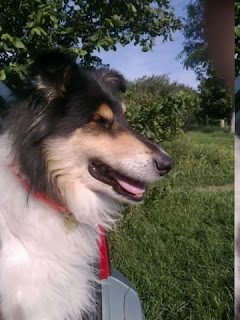 Now here is Claude a few weeks later, in mid June. Note not only the new hair around his face, but the confident air with which he surveys the picnic area at Hills & Dales, watching the other dogs, most of which he now knows quite well, several of which he has been on walks with.
Compare this shot on the left with Claude after his walk with Ozzie and Jill, below. Can it be the same dog?
 Bit by bit, sometimes in small increments, sometimes with great leaps forward, Claude has been growing out of his old timid self into his new life as a confident, if rather arthritic, gent in late-ish middle age. He does still have his foibles, and he does like to test the limits from time to time, but he is definitely both fitter and happier.
 Here is Claude today, at the end of July, after all but 4 months with us. He'd not met Misty before, but he went up to her (he always approaches girls these days) they got on, and she made every effort to come along on his walk. He must have something she liked.
 Claude does know how to have fun now. He runs playfully from one to the other of us, chases the girls he thinks he has a chance with, bounds around forgetting his painful joints when he is feeling exuberant, and so on. He can't keep up the running all that long, but he can trot for quite a while. He looks forward to going out, gets excited when I put on my dog-walk clothes, and generally gives the impression that life is pretty good on the whole. He has entertained more visitors at home (two long-haired dachshund girls that he knows quite well) and is generally becoming sociable.
Up to now he has usually resisted any grooming or deseeding (long hair + country walk = seeds in coat). But today for the first time he took no noticed of the comb in his coat, and didn't even resist when we took seeds out of his rear paws, up to now something he hated. He even stepped into the foot bath when we got home.- that is a real first.
 Here he is at Twywell Hills & Dales picnic area, posing for his photo, with his family. Is this the same dog as the one pictured at the top of the page? Yes, but also no: he is a different dog in that he has acquired a raft of new characteristics which we are proud and pleased to see. We hope he will be with us, and that his personality will continue to grow, for a long while yet.
Bit by bit we've come to understand The Little Man, and to set boundaries and routines that seem to help him. I'll never forget the time he decided not to come when called in the park, and headed off the other way. I will never know what was going on in his head, but I do know that when I finally caught up with him he expected to be hit, and flinched. The brush may well remind him of being groomed, possibly for the first time, in rescue, when, as his coat was so matted, it had to be shaved off almost to the skin. I can imagine that he fought, and he had scars where the clippers had cut him and must have hurt.
Living with him day by day it is easy to be overwhelmed by the effort sometimes needed. His feeding routine, which has certainly taken the anxiety out of meal times for all parties, canine and human, is time consuming and laborious. But he is undoubtedly making progress, and we are enjoying seeing him take strides forward into becoming a more confident, less neurotic dog. Sometimes he seems to take a big step forward almost out of nowhere, like the time, after being lifted into the car 4 times a day, he suddenly leaped in from a standing start and left me open-mouthed. Or the time, after running back to the car whenever he saw a group of two or more dogs approaching ever since we'd had him, he mingled with a group of 7 dogs, exchanging rear-end sniffs, as though he'd been doing it all his life.
This morning was just one of many occasions when we met someone who saw Claude earlier, and has not seem him since, and who expressed their surprise at how much he had come on. Well, he has. After a month of weight loss he stopped losing it, then started gaining. I am expecting him to be heavier still when he is next weighed, so his exercise quota can be increased. He is probably just passing a birthday as he is moulting (male Rough Collies moult once a year) and his coat no longer feels like an out-of-condition horse and is actually soft and smoother. Maybe it will get glossy in time. And he is actually going up to dogs he doesn't know and greeting them, if a bit gingerly at first. This morning he was milling about with 3 Labs, a Spaniel, 2 Great Danes and a Mastiff. You have to remember his flight for the car the first time he met any one of these dogs to appreciate what this means.
So I thought I'd post some pictures, gathering together a few from my Facebook and Picasa albums, to show the road he has travelled and down which we hope he will proceed far in the months and years ahead.


Compare this shot on the left with Claude after his walk with Ozzie and Jill, below. Can it be the same dog?


Up to now he has usually resisted any grooming or deseeding (long hair + country walk = seeds in coat). But today for the first time he took no noticed of the comb in his coat, and didn't even resist when we took seeds out of his rear paws, up to now something he hated. He even stepped into the foot bath when we got home.- that is a real first.

Saturday, 4 June 2011
Violence Against Women
I am aware that I only caught a short part of a discussion on Radio 4 when I was in the car this morning, but as far as I can gather a woman was arguing that porn (all the way from the soft porn of Playboy bunnies to hard porn on the Internet) is the main cause of rape and violence against women.
This is ignorant nonsense. I forget the exact biblical reference, and I don't want to look it up just now, but there is a passage in the OT that runs "If your son disobeys you, remonstrate with him, beat him if necessary, and if he still disobeys you take him to the elders and if he disobeys them, stone him to death". There is no similar sanction of violence against disobedient women. The reason for that is that violence against women was the norm, and in many parts of the world it still is.
For example Islamic teachers have argued recently that it is good for your wife if you beat her and women & girls are ritually murdered in India on a regular basis. The references are easy to find on the web. It is only in the parts of the world that have benefitted from the Enlightenment, where there is freedom of expression, an equal franchise, and so on, that women have equal rights with men to protection under the law.
Those are the same societies that allow porn to some extent under freedom of expression. But protection, for everyone, women included, against violence comes first. To equate porn with the cause of violence against women is simply ignorant of what is happening in much if not most of the world, and against which we should all be protesting as strongly as possible. The guy the woman was arguing with called her "nuts". It's a pity he didn't call her "ignorant" and bring the facts of the matter to her attention.
This is ignorant nonsense. I forget the exact biblical reference, and I don't want to look it up just now, but there is a passage in the OT that runs "If your son disobeys you, remonstrate with him, beat him if necessary, and if he still disobeys you take him to the elders and if he disobeys them, stone him to death". There is no similar sanction of violence against disobedient women. The reason for that is that violence against women was the norm, and in many parts of the world it still is.
For example Islamic teachers have argued recently that it is good for your wife if you beat her and women & girls are ritually murdered in India on a regular basis. The references are easy to find on the web. It is only in the parts of the world that have benefitted from the Enlightenment, where there is freedom of expression, an equal franchise, and so on, that women have equal rights with men to protection under the law.
Those are the same societies that allow porn to some extent under freedom of expression. But protection, for everyone, women included, against violence comes first. To equate porn with the cause of violence against women is simply ignorant of what is happening in much if not most of the world, and against which we should all be protesting as strongly as possible. The guy the woman was arguing with called her "nuts". It's a pity he didn't call her "ignorant" and bring the facts of the matter to her attention.
Sunday, 29 May 2011
Missed Opportunity
My mother was a poetry expert. Actually she earned her living as a Speech Therapist and Elocution Teacher, but what she most enjoyed was working with her senior pupils to get them through the LAMDA and Poetry Society exams. Some of those who came to her went on to be distinguished in various aspects of the dramatic arts. She knew her Shakespeare inside out, and was very fond of Keats and Shelley among others.
Most of this passed me by. A steady drip of poetry, both good and less so, has a similar effect on a child as inoculation. I did learn to appreciate some poets and their work, but not as widely as I might have. And I never took the opportunity to discuss with her the basis of her interpretations. When she advised that a line be rendered this way rather than that, what exactly did she have in mind? Was it the sound, the dramatic effect, the poet's meaning? And if the latter, what did she know of the background against which he was writing?
I know a little about Shakespeare's place in history, not much, and nothing at all about Keats. But I do know quite a bit about Shelley. He married the daughter of one of my heroes, William Godwin, who went on herself to write Frankenstein. Shelley was deeply influenced by Godwin's 1793 book Enquiry Concerning Political Justice, and in some respects was more Godwinian in his views than Godwin had been when he wrote it. Shelley certainly disapproved of adjustments that Godwin made to his theory in later editions of the book in the light of experience. Shelley's poetry is intimately related to Godwin's original philosophy.
And so was his behaviour. Shelley's cavalier attitude towards other people's feelings and opinions, which sprung from his enthusiasm for Godwin's ideas, led indirectly to the suicide of Mary Wollstonecraft's first daughter, Fanny, and directly to the suicide of his first wife, Harriet, who he abandoned for Mary Godwin, and to his subsequent total disinterest in his children from that marriage.
Which is why I would like to have discussed my mother's interpretation of his poetry with her. How much of this did she know? How much of it, if she knew it, did she take into account when teaching his poetry? Did she think that the relationship between the poetic expression of ideas and the behaviour to which those ideas led was important, or even relevant?
I shall never know. Does it matter? Godwin's ideas also form the basis of his daughter Mary Shelley's brilliantly original novel, Frankenstein, and many of the conflicts and questions that arise from his teaching are worked out between the characters of the story. Indeed, it was to popularise her father's insights that Mary wrote the book. But who cares about that now? It's just a darn good story, isn't it?
Tuesday, 12 April 2011
Claude...
Claude has a phobia about doorways. He has yet to leave the living room and enter the hall. Getting him out for a walk has been really difficult. We didn't want to force him and make his fear worse. Despite his not liking being picked up, that's what I resorted to. Once over the threshold he was fine. The odd thing was that it was the threshold out of the living room into the conservatory that stopped him on the way out, and the one from the garden into the conservatory on the way back in. In either direction he crossed the second one without a thought.
So last night Claude had a visit from Canine Behaviourist Sue Kinchin. Because he has problems with his teeth he has also not taken treats. But Sue had some that were tasty enough to attract him and small enough to swallow without chewing. We spent a long time gaining his confidence, rewarding steps towards the door and relieving the stress that built up when he got too near.
However this morning we got the first fruits. I wanted, if it was at all possible, Claude to decide to cross the threshold and go out. He loves his walk, and with his lead on he is highly motivated. He came to the doorway, put a foot across, and then backed off. Then he tried again, but at the threshold he lifted one front leg in the way he does when wanting his chest rubbed. So I did that, and he obviously felt better and put a foot over the doorway again. I rewarded his progress, he backed off. But the next approach he managed two feet through. The point is that he wants to go out, but for some reason he can't. So I rewarded him for his effort - all I had was kind words and my hands - and he backed off but came straight back and tried again. After 45 minutes of to and fro he finally stepped through with all four feet. I made a big fuss of him and he trotted off to the car, through the remaining doorway, no problem.
He also has a issue with getting into the boot. Where we walk in the morning I reverse up to a grassy bank, so he has no trouble getting in and out. After a vigorous walk when he is limbered up he can walk up to the car and leap in. But when his arthritic hip joints are cold he bangs his back legs as he can't get enough height into his jump. I've been trying to teach him the Laddie method - put his front two feet into the car and wait for me to hoick the back end up and in. So he came up to the car, but not near enough. I got him to walk in a circle and this time he stopped closer to the car. But he sat down, clearly recognising that he was going to have a problem leaping in. Then, of his own volition, he put one paw into the car. I praised him and lifted the other paw up and praised him some more. But he was still sitting down and I needed him to be standing up to lift him. So I put my hands under his rear and raised him into the standing position, but before I could get my arm under to lift, he leapt. He didn't have any momentum and banged his legs again, but at least he was a step further towards the right method, so we had a big praising and comfort session before setting off.
After a vigorous walk and many friends to sniff - he as so gained in confidence in the week he's been here - we had to face the reverse issue of getting him to decide to go back into the house. It was exactly the same as it had been in the other direction, just a different doorway. But he was highly motivated - his breakfast was waiting inside, as he well knew. It isn't that he doesn't want to go in. He wants to very much, but some interior mechanism is preventing him, and he can't. So we started the one foot / two feet routine again, with much backing off and walking round. I did my bit, supplying praise and stress-relief. It took him half an hour to make the decision, but he did eventually put all four feet inside and we had a major "well done, take your time and feel better" session. Then he happily trotted across the other threshold that had stopped him on the way out, tucked in to his food, licked his bowl clean, flopped onto the floor and fell asleep.
The Little Man had a demanding start to the day.
So last night Claude had a visit from Canine Behaviourist Sue Kinchin. Because he has problems with his teeth he has also not taken treats. But Sue had some that were tasty enough to attract him and small enough to swallow without chewing. We spent a long time gaining his confidence, rewarding steps towards the door and relieving the stress that built up when he got too near.
However this morning we got the first fruits. I wanted, if it was at all possible, Claude to decide to cross the threshold and go out. He loves his walk, and with his lead on he is highly motivated. He came to the doorway, put a foot across, and then backed off. Then he tried again, but at the threshold he lifted one front leg in the way he does when wanting his chest rubbed. So I did that, and he obviously felt better and put a foot over the doorway again. I rewarded his progress, he backed off. But the next approach he managed two feet through. The point is that he wants to go out, but for some reason he can't. So I rewarded him for his effort - all I had was kind words and my hands - and he backed off but came straight back and tried again. After 45 minutes of to and fro he finally stepped through with all four feet. I made a big fuss of him and he trotted off to the car, through the remaining doorway, no problem.
He also has a issue with getting into the boot. Where we walk in the morning I reverse up to a grassy bank, so he has no trouble getting in and out. After a vigorous walk when he is limbered up he can walk up to the car and leap in. But when his arthritic hip joints are cold he bangs his back legs as he can't get enough height into his jump. I've been trying to teach him the Laddie method - put his front two feet into the car and wait for me to hoick the back end up and in. So he came up to the car, but not near enough. I got him to walk in a circle and this time he stopped closer to the car. But he sat down, clearly recognising that he was going to have a problem leaping in. Then, of his own volition, he put one paw into the car. I praised him and lifted the other paw up and praised him some more. But he was still sitting down and I needed him to be standing up to lift him. So I put my hands under his rear and raised him into the standing position, but before I could get my arm under to lift, he leapt. He didn't have any momentum and banged his legs again, but at least he was a step further towards the right method, so we had a big praising and comfort session before setting off.
After a vigorous walk and many friends to sniff - he as so gained in confidence in the week he's been here - we had to face the reverse issue of getting him to decide to go back into the house. It was exactly the same as it had been in the other direction, just a different doorway. But he was highly motivated - his breakfast was waiting inside, as he well knew. It isn't that he doesn't want to go in. He wants to very much, but some interior mechanism is preventing him, and he can't. So we started the one foot / two feet routine again, with much backing off and walking round. I did my bit, supplying praise and stress-relief. It took him half an hour to make the decision, but he did eventually put all four feet inside and we had a major "well done, take your time and feel better" session. Then he happily trotted across the other threshold that had stopped him on the way out, tucked in to his food, licked his bowl clean, flopped onto the floor and fell asleep.
The Little Man had a demanding start to the day.
Subscribe to:
Posts (Atom)